Alaska Bird Tours
Menu
← Alaska species directory

Aleutians & Pribilofs bird species

A regional directory for western Alaska's island, Bering Sea, and pelagic birding.

Horned Puffin

Photo: Lisa Hupp/USFWS · Alaska · U.S. Fish & Wildlife Service · Public Domain

Alcids

Horned Puffin

Fratercula corniculata

A stocky, tuxedo-colored alcid instantly recognized by its large orange-red bill and the fleshy black 'horn' above each eye in breeding plumage. One of the most sought-after seabirds of the North Pacific, nesting in crevices and caves on rocky sea cliffs throughout the Aleutians and Pribilofs.

Tufted Puffin

Photo: Lisa Hupp/USFWS · Kodiak National Wildlife Refuge, Alaska · U.S. Fish & Wildlife Service · Public Domain

Alcids

Tufted Puffin

Fratercula cirrhata

The largest of the three North American puffins, with a striking all-black body, white face, massive orange-red bill, and sweeping golden head plumes in breeding season. Highly pelagic outside of the nesting period, ranging widely across the North Pacific.

Least Auklet

Photo: Greg Thompson/USFWS · Alaska Maritime National Wildlife Refuge · U.S. Fish & Wildlife Service · Public Domain

Alcids

Least Auklet

Aethia pusilla

The world's smallest alcid — barely larger than a sparrow — yet one of the most numerous seabirds on Earth. Least Auklets breed in staggering numbers on the Pribilofs, with colonies on St. Paul and St. George numbering in the millions. A mosaic of black, white, and gray, with a stubby red-orange bill and a white facial plume.

Crested Auklet

Photo: Art Sowls/USFWS · St. George Island, Pribilof Islands, Alaska · U.S. Fish & Wildlife Service · Public Domain

Alcids

Crested Auklet

Aethia cristatella

A charismatic medium-sized auklet with a dramatic forward-curling black crest, a stubby orange bill decorated with pale plates, and a distinctive citrus-like scent during breeding season. Forms enormous mixed-species flocks with Least Auklets at the Pribilofs.

Parakeet Auklet

Photo: Lisa Hupp/USFWS · U.S. Fish & Wildlife Service · Public Domain

Alcids

Parakeet Auklet

Aethia psittacula

A striking auklet with a rounded orange-red bill that curves upward at the tip, giving it an almost comical expression. The white facial plume, white underparts, and dark upperparts make it one of the most readily identifiable auklets. Less colonial than Least or Crested Auklets, preferring scattered nest sites on cliff faces.

Whiskered Auklet

Photo: USGS · Aleutian Islands, Alaska · U.S. Fish & Wildlife Service · Public Domain

Alcids

Whiskered Auklet

Aethia pygmaea

One of the most ornate of all alcids, the Whiskered Auklet sports three white facial plumes — two from above the eye and one from below — plus a recurved black crest. Largely confined to the Aleutian Islands, making it a prized target for visiting birders. Its habit of foraging in tidal rips around island passes is well-known.

Northern Fulmar

Photo: Steve Hillebrand/USFWS · Chagulak Island, Aleutian Islands, Alaska · U.S. Fish & Wildlife Service · Public Domain

Seabirds

Northern Fulmar

Fulmarus glacialis

A supremely pelagic seabird that glides on stiff wings just above wave crests. Northern Fulmars occur in two color morphs — dark (predominant in the Pacific) and light — and are among the most commonly encountered birds on any Bering Sea or North Pacific pelagic trip. They congregate in large numbers around fishing vessels.

Short-tailed Shearwater

Photo: Michael L. Baird · Wikimedia Commons · CC BY 2.0

Seabirds

Short-tailed Shearwater

Ardenna tenuirostris

The most numerous shearwater in Alaskan waters, with estimated Pacific populations exceeding 20 million. Short-tailed Shearwaters breed in Australia and undertake one of the longest migrations of any bird, passing through Alaskan waters in enormous flocks during spring and fall. Uniform sooty-brown with a pale underwing flash.

Fork-tailed Storm-Petrel

Photo: Carla Stanley · Alaska Maritime National Wildlife Refuge · U.S. Fish & Wildlife Service · Public Domain

Seabirds

Fork-tailed Storm-Petrel

Oceanodroma furcata

A pale blue-gray storm-petrel with a forked tail — one of only two storm-petrels in the world with pale plumage. Flutters and glides low over the wave surface, pattering its feet on the water. Breeds in burrows on grassy islands throughout the Aleutians and Pribilofs.

Red-legged Kittiwake

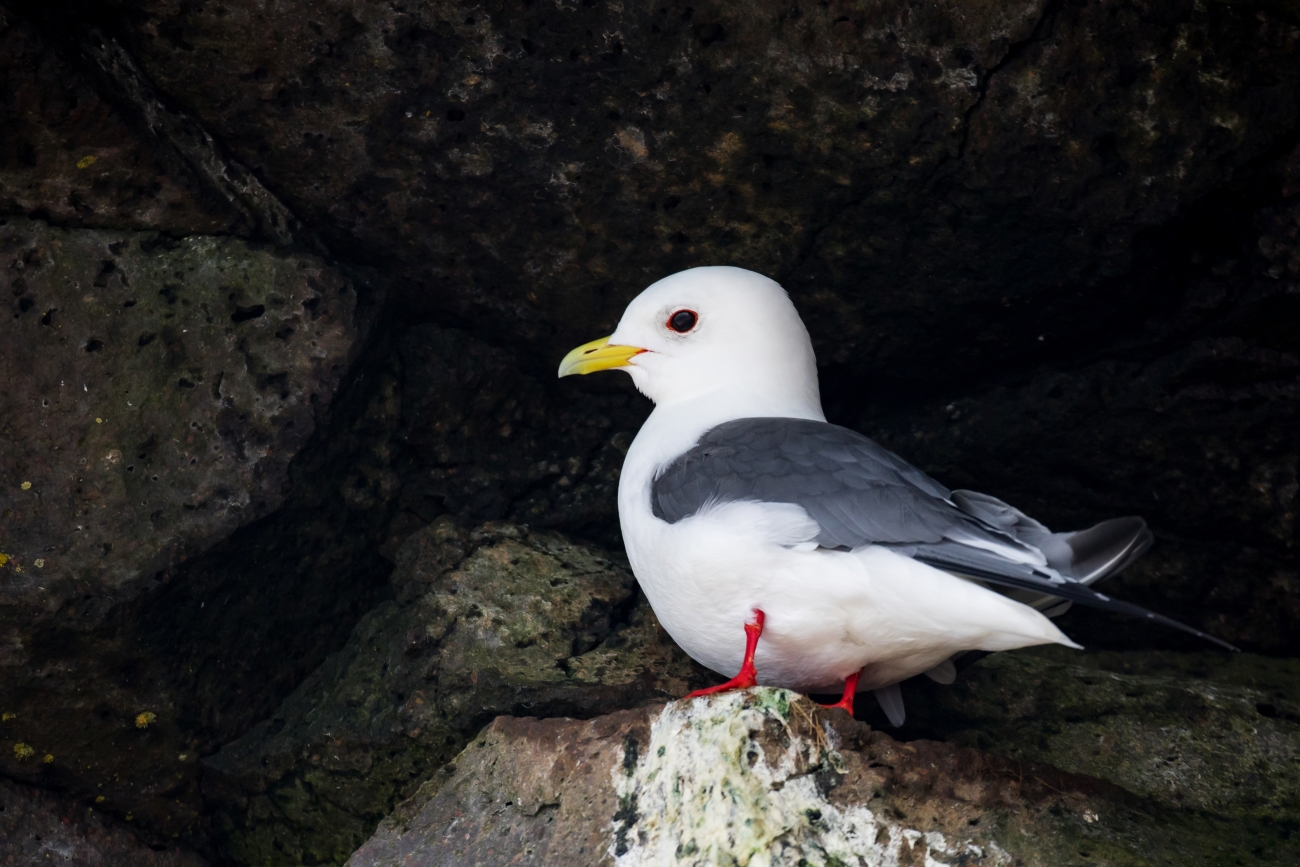
Photo: Lisa Hupp/USFWS · Alaska · U.S. Fish & Wildlife Service · Public Domain

Gulls & Terns

Red-legged Kittiwake

Rissa brevirostris

A regional specialty almost entirely confined to the Pribilof Islands, the Red-legged Kittiwake is distinguished from the closely related Black-legged Kittiwake by its vivid coral-red legs, shorter bill, larger eyes, darker mantle, and white underwings. One of the most localized seabirds in North America.

Steller's Eider

Photo: Laura L. Whitehouse/USFWS · Alaska SeaLife Center, Seward, Alaska · U.S. Fish & Wildlife Service · Public Domain

Waterfowl

Steller's Eider

Polysticta stelleri

The smallest and most distinctive of the four eider species, the male Steller's Eider has a striking white head with a dark eye patch, chestnut breast, and pale body. Listed as threatened under the U.S. Endangered Species Act due to population declines. Molting flocks congregate on the shallow lagoons of the Alaska Peninsula and Aleutians.

Spectacled Eider

Photo: Laura L. Whitehouse/USFWS · Alaska SeaLife Center, Seward, Alaska · U.S. Fish & Wildlife Service · Public Domain

Waterfowl

Spectacled Eider

Somateria fischeri

A large sea duck named for the male's distinctive pale green 'spectacles' — large circular patches of goose-bumpy white feathers surrounding each eye, bordered by black. Listed as threatened under the U.S. Endangered Species Act. Remarkable for wintering in a single large polynya (open water surrounded by sea ice) in the Bering Sea.

Emperor Goose

Photo: Lisa Hupp/USFWS · Kodiak National Wildlife Refuge, Alaska · U.S. Fish & Wildlife Service · Public Domain

Waterfowl

Emperor Goose

Anser canagicus

A stocky, handsome goose with a white head and neck contrasting sharply with a blue-gray body and black throat. The Emperor Goose is largely endemic to Alaska and far-eastern Russia, with most of the world's population wintering along the Alaska Peninsula and Aleutian Islands. A highly localized species that draws dedicated birders to the region.

Rock Sandpiper

Photo: Donna A. Dewhurst/USFWS · Alaska · U.S. Fish & Wildlife Service · Public Domain

Shorebirds

Rock Sandpiper

Calidris ptilocnemis

A stocky, chunky shorebird that clings to wave-washed rocks and kelp beds along the Aleutian coastline — the only regularly occurring shorebird in the Aleutians in winter. The Pribilofs subspecies (*ptilocnemis*) is the palest and largest, with a distinctive white-flecked gray plumage quite different from the breeding-plumage bird.

Bar-tailed Godwit

Photo: BLM Alaska · National Petroleum Reserve in Alaska · Bureau of Land Management / Wikimedia Commons · Public Domain

Shorebirds

Bar-tailed Godwit

Limosa lapponica

A large, long-billed shorebird famous for completing the longest non-stop migratory flight of any bird: up to 7,400 miles in a single flight from Alaska to New Zealand. Bar-tailed Godwits stage in large numbers along the Alaska Peninsula and Aleutian coastlines before their record-breaking transoceanic migration.

Red-faced Cormorant

Photo: Lisa Hupp/USFWS · Alaska · U.S. Fish & Wildlife Service · Public Domain

Cormorants

Red-faced Cormorant

Urile urile

A large, iridescent cormorant with a distinctive bright red face and blue throat pouch in breeding plumage. Found almost exclusively in Alaska and the Russian Far East, with the Aleutians and Pribilofs forming the core of its range. Closely associated with rocky sea cliffs where it nests alongside kittiwakes and murres.

McKay's Bunting

Photo: Anne Morkill · Hall Island, Alaska Maritime National Wildlife Refuge · U.S. Fish & Wildlife Service · Public Domain

Passerines

McKay's Bunting

Plectrophenax hyperboreus

One of the rarest and most localized songbirds in North America, McKay's Bunting breeds almost exclusively on remote St. Matthew and Hall Islands in the Bering Sea, with virtually the entire global population wintering along the western Alaska coast. Males are strikingly white — more so than the closely related Snow Bunting — with minimal black in the wings.

Brambling

Photo: Dirk-Jan van Roest · Wikimedia Commons · CC BY 2.0

Passerines

Brambling

Fringilla montifringilla

A Eurasian finch that is an irregular but annual vagrant to Alaska, arriving on the Aleutians and Pribilofs during autumn migration. Males in breeding plumage have a striking black head, orange breast and shoulders, and a distinctive white rump visible in flight. Most Alaskan records are of fall birds in muted non-breeding plumage.

Common Sandpiper

Photo: Ganesh Mohan T · Wikimedia Commons · CC BY-SA 4.0

Shorebirds

Common Sandpiper

Actitis hypoleucos

The Eurasian counterpart to the Spotted Sandpiper, the Common Sandpiper is a regular vagrant to the western Aleutians and Pribilofs. Identified by its constant teetering motion, brown-washed upperparts, a distinctive white 'shoulder' notch, and clean white underparts. A sought-after shorebird for birders visiting Attu or St. Paul Island.

Short-tailed Albatross

Photo: Robin Corcoran/USFWS · Alaska Maritime National Wildlife Refuge · U.S. Fish & Wildlife Service · Public Domain

Seabirds

Short-tailed Albatross

Phoebastria albatrus

The largest seabird regularly occurring in Alaskan waters, with a wingspan exceeding 7 feet. Once hunted nearly to extinction for the feather trade, the Short-tailed Albatross has slowly recovered from a low of around 10 birds in the 1940s to several thousand today. Adults have a largely white body, golden-yellow head, and massive pink bill — unmistakable when seen at sea.