Alaska Bird Tours
Menu

Bird directory

Alaska bird species

A statewide directory built from the site's existing species dataset. Legacy region-specific notes are labeled rather than presented as statewide guarantees.

Tufted Puffin

Photo: Lisa Hupp/USFWS · Kodiak National Wildlife Refuge, Alaska · U.S. Fish & Wildlife Service · Public Domain

Seabirds

Tufted Puffin

Fratercula cirrhata

A striking seabird with a bright orange bill and long golden head plumes during breeding season. Tufted Puffins nest in burrows on steep, grassy sea cliffs and spend winters far out at sea.

Arctic Warbler

Photo: OlgaC · Wikimedia Commons · CC BY-SA 3.0

Warblers

Arctic Warbler

Phylloscopus borealis

A small Old World warbler that breeds in Alaska, notable for its distinctive single-wing-bar and buzzy trill song. It is the only Old World warbler that regularly breeds in North America.

Bald Eagle

Photo: Peter Pearsall/USFWS · U.S. Fish & Wildlife Service · Public Domain

Raptors

Bald Eagle

Haliaeetus leucocephalus

North America's iconic raptor, easily recognized by its white head and tail contrasting with a dark brown body. Adults have a massive yellow bill and powerful talons used for catching fish.

Common Raven

Photo: Ken Thomas · Wikimedia Commons · CC0 1.0

Corvids

Common Raven

Corvus corax

A large, entirely black corvid with a thick bill, shaggy throat feathers, and a wedge-shaped tail in flight. Ravens are among the most intelligent birds, capable of problem-solving and play.

American Crow

Photo: Walter Siegmund · Wikimedia Commons · CC BY-SA 3.0

Corvids

American Crow

Corvus brachyrhynchos

A medium-sized, all-black corvid smaller than a raven, with a fan-shaped tail and a familiar cawing call. The Northwestern Crow was formerly treated as a separate species but was lumped with American Crow in 2020.

Red-tailed Hawk

Photo: Alan D. Wilson · Wikimedia Commons · CC BY-SA 2.5

Raptors

Red-tailed Hawk

Buteo jamaicensis

A large, broad-winged hawk best known for its brick-red tail in adults. The Harlan's subspecies, common in Alaska, is darker overall and may lack the classic red tail.

Great Blue Heron

Photo: Me in ME · Wikimedia Commons · CC BY-SA 4.0

Waterbirds

Great Blue Heron

Ardea herodias

The largest heron in North America, standing up to four feet tall with blue-gray plumage, a white face, and a bold black eye stripe. It hunts by standing motionless at the water's edge.

Eurasian Collared-Dove

Photo: JohnnyCigar · Wikimedia Commons · CC BY 3.0

Songbirds

Eurasian Collared-Dove

Streptopelia decaocto

A pale, sandy-colored dove with a distinctive black crescent on the back of its neck. Originally from Eurasia, it has rapidly expanded across North America since the 1980s.

Belted Kingfisher

Photo: Jac. Janssen · Wikimedia Commons · CC BY 2.0

Songbirds

Belted Kingfisher

Megaceryle alcyon

A stocky, large-headed bird with a shaggy crest and a long, dagger-like bill. Females are more colorful than males, sporting an extra rusty belly band — unusual among birds.

Steller's Jay

Photo: S. Taheri · Wikimedia Commons · CC BY-SA 4.0

Corvids

Steller's Jay

Cyanocitta stelleri

A bold, crested jay with a dark head and brilliant blue body. It is the only crested jay west of the Rocky Mountains and is closely related to the Blue Jay.

Glaucous-winged Gull

Photo: Dick Daniels · Wikimedia Commons · CC BY-SA 3.0

Gulls

Glaucous-winged Gull

Larus glaucescens

The most common large gull in Southeast Alaska, with pale gray wingtips that match the mantle. Adults have a white head, pink legs, and a yellow bill with a red spot.

Herring Gull

Photo: Caleb Putnam · Wikimedia Commons · CC BY-SA 2.5

Gulls

Herring Gull

Larus argentatus

A large gull with a pale gray mantle and black wingtips marked with white mirrors. Adults have pink legs and a yellow bill with a red gonydeal spot.

Short-billed Gull

Photo: Jerzy Strzelecki · Wikimedia Commons · CC BY-SA 3.0

Gulls

Short-billed Gull

Larus brachyrhynchus

A medium-sized gull with a gentle expression, dark eyes, and a small yellow-green bill. Formerly known as Mew Gull, it was split into its own species in 2021.

Black-legged Kittiwake

Photo: Ómar Runólfsson · Wikimedia Commons · CC BY 2.0

Gulls

Black-legged Kittiwake

Rissa tridactyla

A graceful, medium-sized gull of the open ocean with solid black wingtips that look dipped in ink, a yellow bill, and black legs. It nests on sheer sea cliffs in dense, noisy colonies.

Bonaparte's Gull

Photo: Dick Daniels · Wikimedia Commons · CC BY-SA 3.0

Gulls

Bonaparte's Gull

Chroicocephalus philadelphia

One of North America's smallest gulls, with a black hood in breeding plumage and a buoyant, tern-like flight. Unlike most gulls, it nests in trees rather than on the ground.

Pigeon Guillemot

Photo: Mike Baird · Wikimedia Commons · CC BY 2.0

Seabirds

Pigeon Guillemot

Cepphus columba

A medium-sized alcid with striking black plumage, bold white wing patches, and bright red-orange feet and mouth lining. It is a skilled diver that swims underwater using its wings.

Marbled Murrelet

Photo: USFWS Pacific Region · Wikimedia Commons · CC BY 2.0

Seabirds

Marbled Murrelet

Brachyramphus marmoratus

A small, secretive seabird with brown marbled breeding plumage. It is one of the rarest and most unusual alcids — nesting high in the mossy branches of old-growth trees, sometimes miles from the ocean.

Pelagic Cormorant

Photo: Sandy Cole · Wikimedia Commons · CC BY 2.0

Waterbirds

Pelagic Cormorant

Urile pelagicus

The smallest and slimmest cormorant in North America, with glossy dark plumage showing green and violet iridescence in good light. In breeding season, adults develop white flank patches and small red face patches.

Greater Yellowlegs

Photo: Shanthanu Bhardwaj · Wikimedia Commons · CC BY-SA 2.0

Shorebirds

Greater Yellowlegs

Tringa melanoleuca

A tall, elegant shorebird with long bright-yellow legs and a slightly upturned bill. Its loud, ringing three-note call carries across wetlands and often alerts other birds to approaching danger.

Spotted Sandpiper

Photo: JMHullot · Wikimedia Commons · CC BY-SA 3.0

Shorebirds

Spotted Sandpiper

Actitis macularius

A small shorebird recognized by its bold black breast spots in breeding plumage and its distinctive teetering walk. It is the most widespread breeding sandpiper in North America.

Wilson's Snipe

Shorebirds

Wilson's Snipe

Gallinago delicata

A stocky, cryptically patterned shorebird with an extremely long, straight bill and bold striping on the head. It probes deep into soft mud for invertebrates, often remaining hidden until flushed at close range.

Red-breasted Sapsucker

Photo: Becky Matsubara · Wikimedia Commons · CC BY 2.0

Woodpeckers

Red-breasted Sapsucker

Sphyrapicus ruber

A striking woodpecker with an entirely red head and breast, a white wing patch, and a pale yellow belly. It drills neat rows of sap wells in tree bark and returns to feed on the oozing sap.

Hairy Woodpecker

Photo: Minette Layne · Wikimedia Commons · CC BY-SA 2.0

Woodpeckers

Hairy Woodpecker

Dryobates villosus

A medium-sized black-and-white woodpecker with a long, chisel-like bill and a bold white back stripe. Males have a small red patch on the back of the head.

Tree Swallow

Photo: Cephas · Wikimedia Commons · CC BY-SA 3.0

Swallows & Swifts

Tree Swallow

Tachycineta bicolor

A sleek swallow with iridescent blue-green upperparts and clean white underparts. It is one of the earliest swallows to arrive in spring and readily uses nest boxes.

Barn Swallow

Photo: Ian Kirk · Wikimedia Commons · CC BY 2.0

Swallows & Swifts

Barn Swallow

Hirundo rustica

The most widespread swallow in the world, recognized by its deeply forked tail, blue-black upperparts, and rusty-orange throat. It builds cup-shaped mud nests on buildings and bridges.

Vaux's Swift

Photo: Becky Matsubara · Wikimedia Commons · CC BY 2.0

Swallows & Swifts

Vaux's Swift

Chaetura vauxi

A small, cigar-shaped bird with rapid, flickering wingbeats and a high-pitched chittering call. It spends nearly its entire life on the wing, roosting inside hollow trees and chimneys.

Song Sparrow

Photo: Ron Knight · Wikimedia Commons · CC BY 2.0

Sparrows

Song Sparrow

Melospiza melodia

A medium-sized streaky sparrow with a bold central breast spot and a rich, melodious song. Southeast Alaska birds are among the darkest and largest subspecies.

Lincoln's Sparrow

Photo: Dominic Sherony · Wikimedia Commons · CC BY-SA 2.0

Sparrows

Lincoln's Sparrow

Melospiza lincolnii

A shy, finely streaked sparrow with buffy breast streaks, a buffy moustache stripe, and a distinctive wren-like bubbling song. Often stays hidden in dense vegetation.

Savannah Sparrow

Photo: Cephas · Wikimedia Commons · CC BY-SA 3.0

Sparrows

Savannah Sparrow

Passerculus sandwichensis

A small, streaky grassland sparrow with a yellowish eyebrow stripe and a short, notched tail. Its thin, buzzy song is a characteristic sound of open fields and meadows.

Fox Sparrow

Photo: Cephas · Wikimedia Commons · CC BY-SA 3.0

Sparrows

Fox Sparrow

Passerella iliaca

A large, robust sparrow with heavily streaked and spotted underparts and a rufous tail. The Sooty subspecies found in Southeast Alaska is dark chocolate-brown overall.

Dark-eyed Junco (Oregon race)

Photo: Wolfgang Wander · Wikimedia Commons · CC BY-SA 3.0

Sparrows

Dark-eyed Junco (Oregon race)

Junco hyemalis

A small, neat sparrow with a dark hood, rusty-brown back, pinkish-brown sides, and white outer tail feathers that flash in flight. The Oregon subspecies is the form found in Southeast Alaska.

Golden-crowned Kinglet

Songbirds

Golden-crowned Kinglet

Regulus satrapa

One of North America's smallest songbirds, with olive-green plumage, bold white wing bars, and a brilliant golden-orange crown stripe bordered by black. It flicks its wings nervously as it forages.

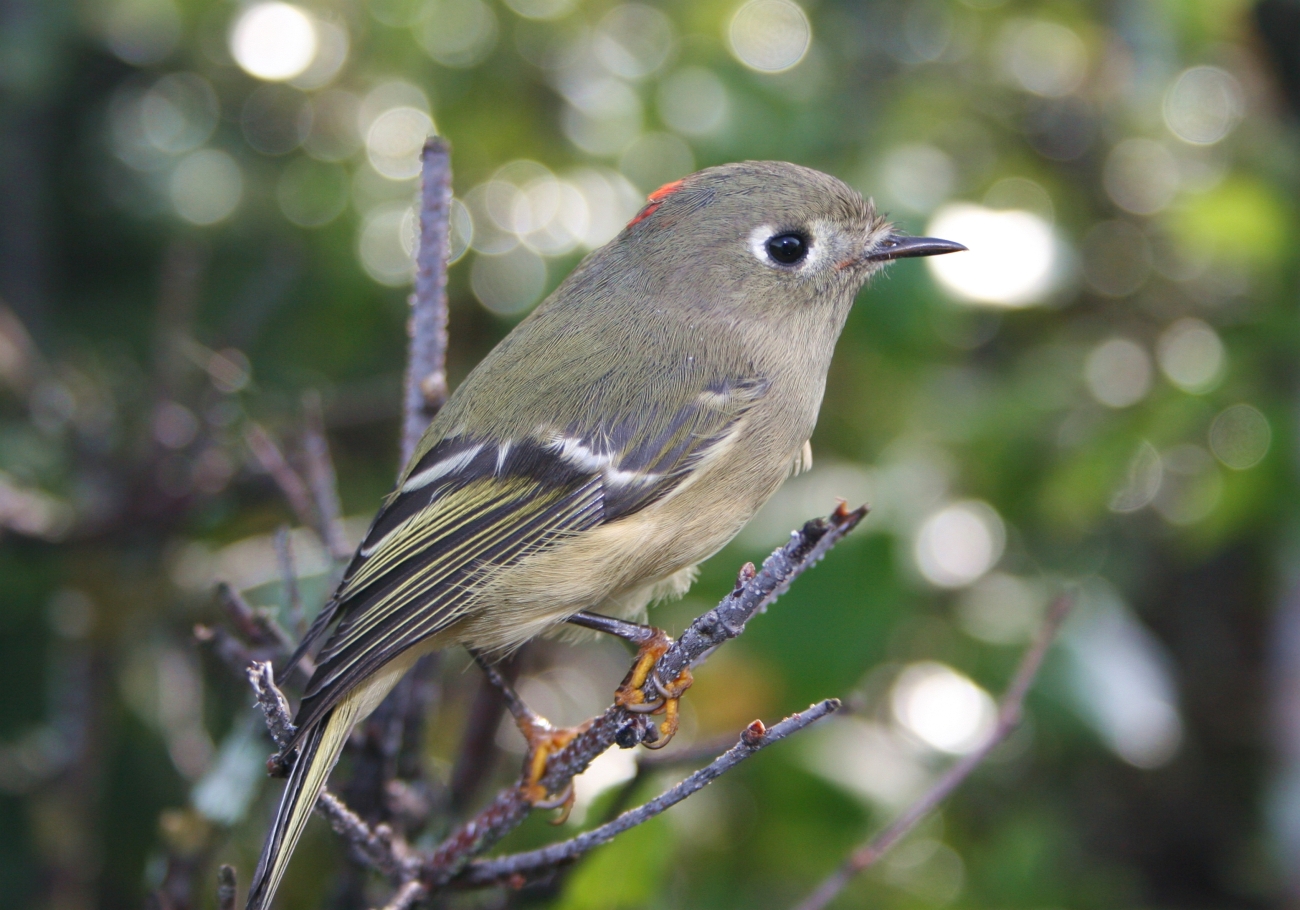
Ruby-crowned Kinglet

Photo: Donna A. Dewhurst/USFWS · BLM Campbell Tract, Anchorage, Alaska · U.S. Fish & Wildlife Service · Public Domain

Songbirds

Ruby-crowned Kinglet

Corthylio calendula

A tiny, active songbird with olive-green plumage, a bold white eye-ring, and a hidden ruby-red crown patch that males flash when excited. Its loud, cascading song is surprisingly powerful for its size.

Brown Creeper

Photo: Manjith Kainickara · Wikimedia Commons · CC BY-SA 2.0

Songbirds

Brown Creeper

Certhia americana

A small, cryptically patterned bird that spirals up tree trunks searching for insects in bark crevices. Its brown-streaked plumage is perfectly camouflaged against tree bark.

Pacific Wren

Photo: Becky Matsubara · Wikimedia Commons · CC BY 2.0

Songbirds

Pacific Wren

Troglodytes pacificus

A tiny, dark brown wren with a short cocked tail and an incredibly complex, cascading song that rings through the understory of old-growth forests. It was formerly lumped with the Winter Wren.

Rufous Hummingbird

Photo: Manjith Kainickara · Wikimedia Commons · CC BY-SA 2.0

Songbirds

Rufous Hummingbird

Selasphorus rufus

A small, feisty hummingbird — the male blazes with iridescent orange-red plumage and a brilliant scarlet gorget. It undertakes one of the longest migrations relative to body size of any bird.

American Robin

Photo: Steve Maslowski / USFWS · Wikimedia Commons · CC BY 2.0

Thrushes

American Robin

Turdus migratorius

A familiar large thrush with a warm orange-red breast, dark gray upperparts, and a cheerful caroling song. It is one of the most widespread and recognizable songbirds in North America.

Varied Thrush

Photo: Becky Matsubara · Wikimedia Commons · CC BY 2.0

Thrushes

Varied Thrush

Ixoreus naevius

A stunning thrush of the Pacific Northwest rainforest, resembling a robin but with a bold black breast band, orange eyebrow stripe, and orange wing bars. Its haunting, single-note whistle echoes through misty forests.

Hermit Thrush

Thrushes

Hermit Thrush

Catharus guttatus

A shy, spotted thrush with a reddish tail that it slowly raises and lowers — a distinctive habit. Its ethereal, flute-like song is considered one of the most beautiful of any North American bird.

Swainson's Thrush

Thrushes

Swainson's Thrush

Catharus ustulatus

A medium-sized thrush with warm brown upperparts, buffy eye-ring, and spotted breast. Its upward-spiraling, flute-like song is one of the defining sounds of northern forests in summer.

Orange-crowned Warbler

Photo: Becky Matsubara · Wikimedia Commons · CC BY 2.0

Warblers

Orange-crowned Warbler

Leiothlypis celata

A plain olive-yellow warbler with faint breast streaking and a rarely visible orange crown patch. It is one of the most common and widespread warblers in western North America.

Yellow-rumped Warbler

Photo: Jac. Janssen · Wikimedia Commons · CC BY 2.0

Warblers

Yellow-rumped Warbler

Setophaga coronata

A handsome warbler with a bright yellow rump, yellow side patches, and a yellow crown patch. The Myrtle subspecies, found in Alaska, has a white throat and bold black streaking.

Yellow Warbler

Warblers

Yellow Warbler

Setophaga petechia

A brilliant all-yellow warbler with reddish-brown breast streaks in males. It is one of the most widespread warblers in North America and a quintessential bird of willow thickets.

Wilson's Warbler

Photo: Len Blumin · Wikimedia Commons · CC BY 2.0

Warblers

Wilson's Warbler

Cardellina pusilla

A small, active warbler with bright yellow underparts and a distinctive round black cap in males. It forages restlessly in dense undergrowth, flicking its tail constantly.

Townsend's Warbler

Photo: VJAnderson · Wikimedia Commons · CC BY-SA 4.0

Warblers

Townsend's Warbler

Setophaga townsendi

A striking warbler with a black-and-yellow face pattern, olive-green back, and bold black streaking on yellow underparts. It forages high in the canopy of coniferous forests.

Western Flycatcher

Photo: Becky Matsubara · Wikimedia Commons · CC BY 2.0

Flycatchers

Western Flycatcher

Empidonax difficilis

A small, olive-green flycatcher with a yellowish wash on the belly, teardrop-shaped eye-ring, and a distinctive rising "su-weet" call. Formerly known as Pacific-slope Flycatcher before the 2023 re-lump.

Olive-sided Flycatcher

Photo: Becky Matsubara · Wikimedia Commons · CC BY 2.0

Flycatchers

Olive-sided Flycatcher

Contopus cooperi

A stout, large-headed flycatcher that perches on the very tops of tall snags and conifers, singing its emphatic "Quick, THREE BEERS!" song. It has a distinctive dark vest on white underparts.

Red Crossbill (Type 3)

Photo: Ron Knight · Wikimedia Commons · CC BY 2.0

Finches

Red Crossbill (Type 3)

Loxia curvirostra

A stocky finch with distinctive crossed mandibles uniquely adapted for prying open conifer cone scales. Males are brick-red and females olive-yellow. Type 3 is the Western Hemlock specialist found in Southeast Alaska.

White-winged Crossbill

Photo: Cephas · Wikimedia Commons · CC BY-SA 3.0

Finches

White-winged Crossbill

Loxia leucoptera

A crossbill distinguished from its Red cousin by bold white wing bars and a slightly smaller bill adapted for smaller conifer cones. Males are rosy-pink and females are olive-yellow with streaking.

Pine Siskin

Photo: Becky Matsubara · Wikimedia Commons · CC BY 2.0

Finches

Pine Siskin

Spinus pinus

A small, heavily streaked finch with subtle yellow flashes in the wings and tail, visible in flight. It is highly gregarious and travels in noisy, restless flocks through coniferous forests.